
Total solar eclipse
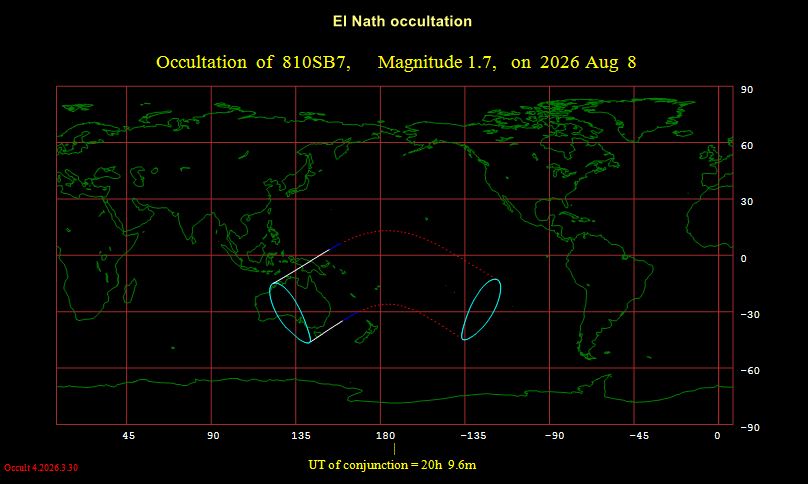
Perhaps the biggest astronomical event of this month is the total solar eclipse on August 12. Check out the clickable visibility map. Partial phases are visible over most of Canada, the northern United States, far northeast Russia, western Europe, western Africa, and the northern Atlantic Ocean. The path of totality goes close to the north pole, across Greenland, along the west coast of Iceland, and across northern Spain. For Iceland, it’s the first total solar eclipse since 1954 and the last until 2196! Iceland gets the longest totality of this eclipse at around two minutes, 18 seconds. Spain hasn’t had a total solar eclipse since 1905. But after this one, there’s another total solar eclipse in that country next year.

If you’re anywhere where any part of this eclipse can be seen, remember to protect your eyes. Only during totality can you look at the eclipsed solar disk without protection. During all other parts and when the sun’s not eclipsed, you have to use a solar filter made specifically for safe solar viewing or you need to have a way of safely projecting an image of the sun. Don’t trust old film negatives, stacks of sunglasses, or other dark materials that weren’t made for eclipse viewing.
Partial lunar eclipse
This month’s full moon comes with a partial eclipse. The partial phase from beginning to end lasts about three hours, 20 minutes. That’ll be from 02:33 to 05:52 Universal Time on the 20th. For much of the western hemisphere, it starts on the evening of the 19th. The entire event is visible from anywhere in South America, weather permitting. Most of North America gets most or all of the event. The moon will set during the eclipse for those watching from Europe and Africa. Check out the SkyCaramba eclipse visibility map.

This eclipse is rather deep as partial eclipses go. Its umbral magnitude is 0.93. If the entire lunar disk just barely went entirely into Earth’s shadow, the umbral magnitude would be exactly one. 0.93 means 93% of the moon’s diameter is in the deepest part of Earth’s shadow. That shadow at moon distances is bigger than the moon. So if the moon were to go deeper into it as happens in some eclipses, the magnitude would be more than one. For the event Thursday night to Friday morning, just a tiny piece of the northwestern part of the lunar disk will be out of the darkest part of the shadow at maximum eclipse. If you could see the sun from that part of the moon, it would be partially eclipsed by the earth.
It’s totally safe to look at the moon without any eye protection during an eclipse. However, if you use a telescope, you might find it easier on your eye to have a moon filter. It’s nowhere near as dark as a sun filter, because it doesn’t have to be. Moonlight’s not bright enough to blind you, although in a magnified view it can be bright enough to be uncomfortable. Some moon filters are adjustable. They’re made with two polarized filters. A polarized filter tries to pass light in only one orientation. Put two of them together with their polarities 90° off from each other and you get very little light through. Turn one of them so they’re aligned and you get maximum light pass-through. With that kind of moon filter, you can adjust the brightness to your liking. Sometimes a tinted filter adds some color and contrast to lunar features to make them easier to see.
Planets
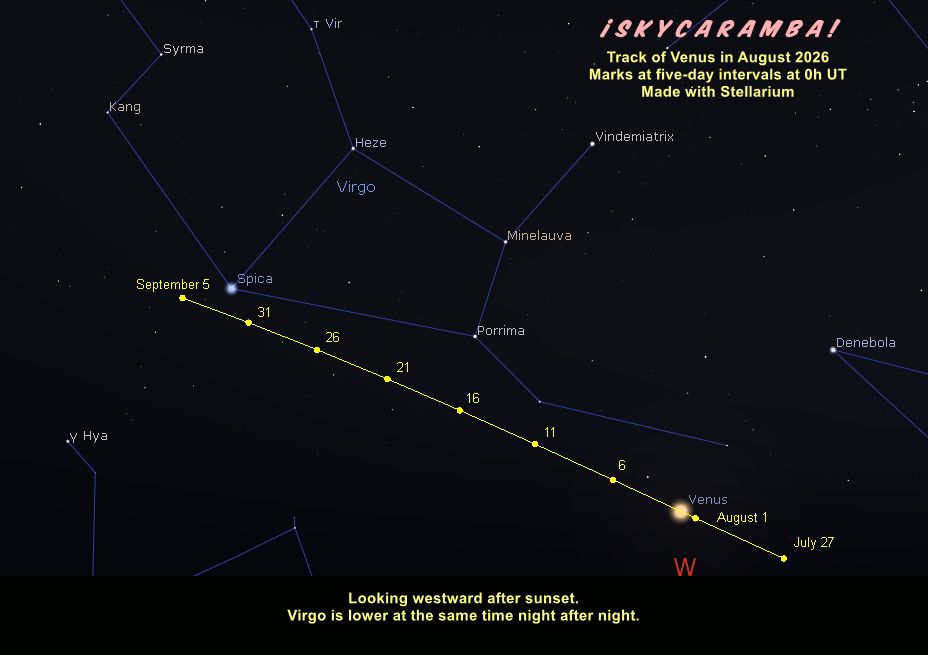
Venus is an evening object all month. It slides alongside Virgo in the west at dusk. After passing the star Zaniah on the 11th, the moon passes by Venus on the 15th and 16th. Venus is at its greatest elongation east of the sun, 45.9 degrees, on the 15th. Then Venus is close to Porrima on the 17th. As the month ends, the planet is approaching Spica. The planet and star will be closest on September 1. In a telescope, Venus should appear to be at dichotomy (semi-circle phase) about the 8th with the mathematical dichotomy calculated for the 12th. Evening dichotomy seems to be four nights early for reasons scientists don’t completely agree on.
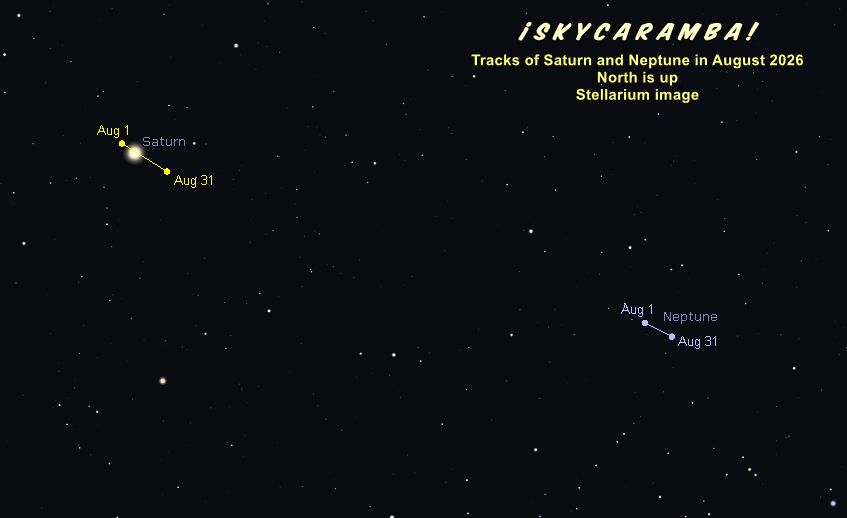
Neptune is retrograde alongside Pisces. The moon passes by on the 3rd and again on the 30th.
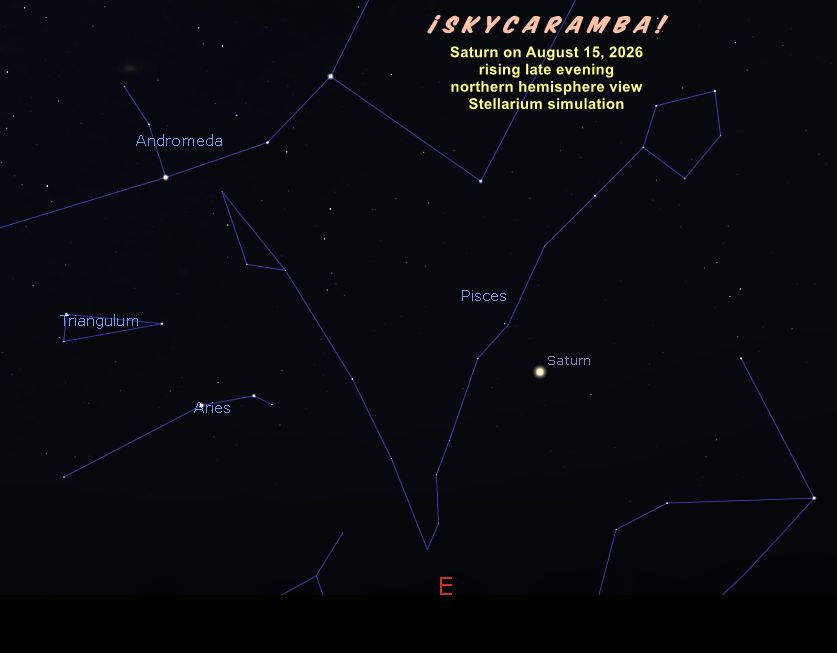
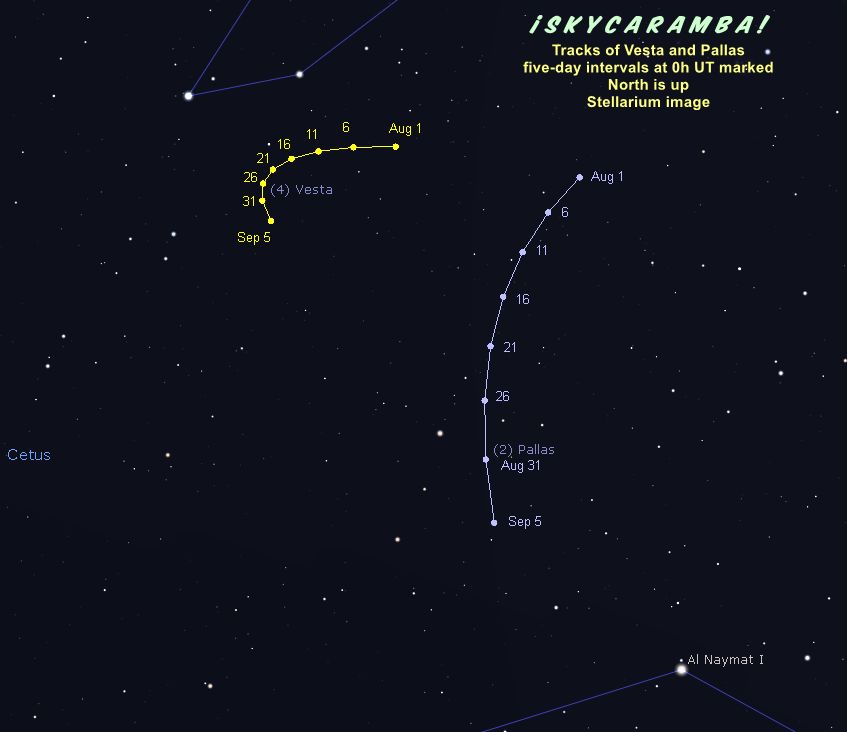
Saturn rises late evening early in the month and mid-evening later in the month. It’s practically stationary but slowly retrograde on the west side of Pisces very close to the border with Cetus. A waning gibbous moon passes the ringed planet on the 3rd.
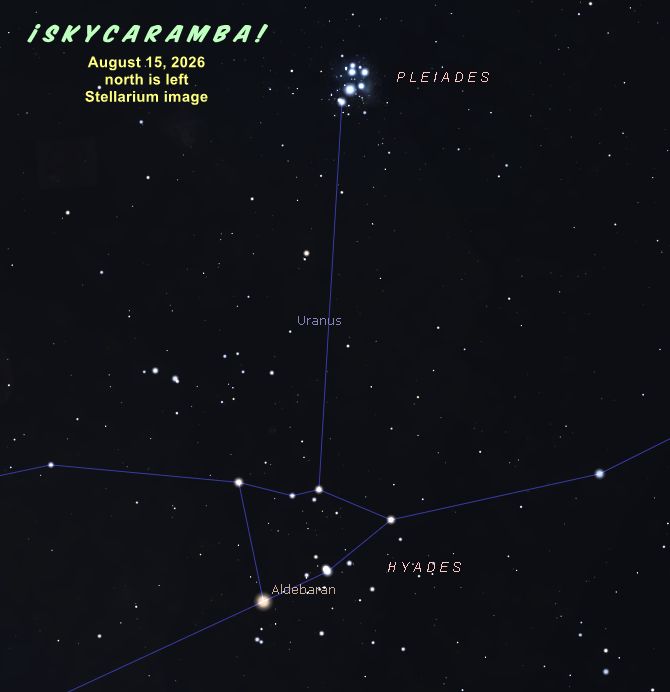
Uranus rises a little after midnight, slowly moving prograde in Taurus between the Hyades and Pleiades. A waning crescent moon passes on the 7th and 8th.
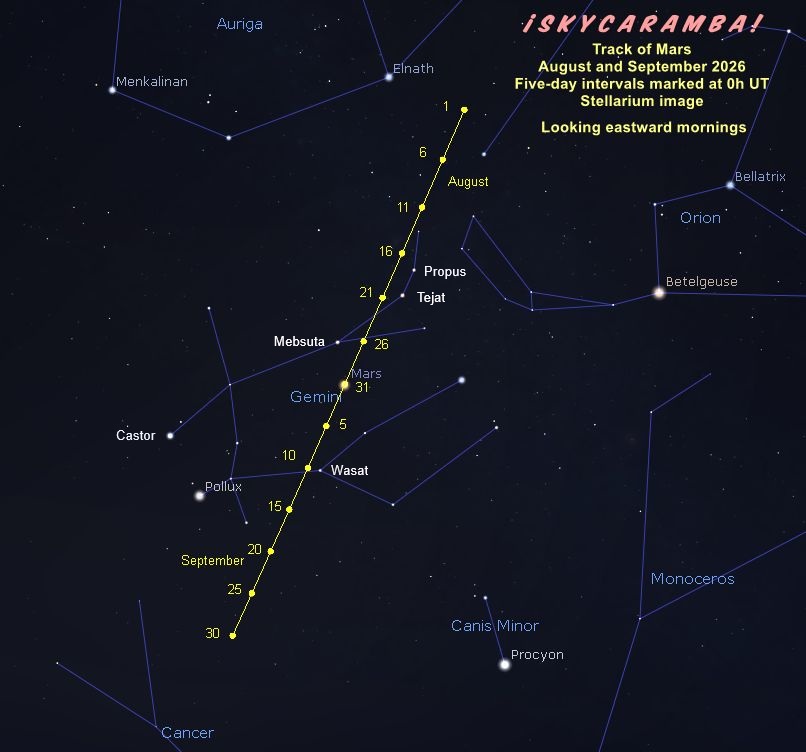
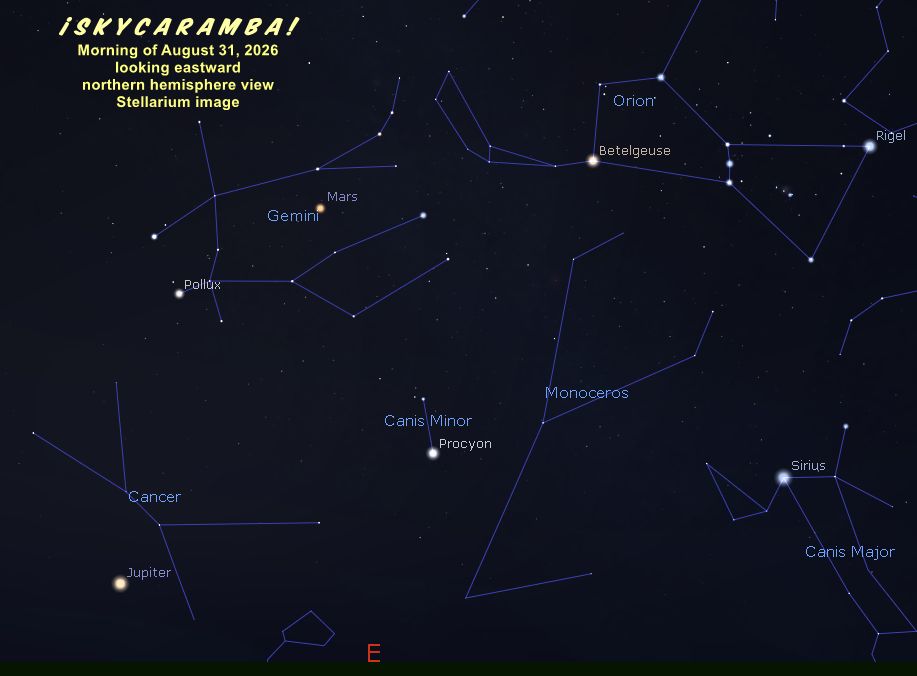
Mars rises a little later than Uranus. It should be far enough from the Hyades to not be mistaken for orange Aldebaran. But in case you need to know, the red planet isn’t part of the celestial V. The region south of Elnath is in Taurus. That’s where Mars starts this month. It quickly moves eastward toward the feet of Gemini. It’s almost there when the waning crescent moon passes on the 9th. In Gemini, Mars is north of Propus on the 17th, north of Tejat on the 20th, and south of Mebsuta on the 26th. In a telescope, the Martian north pole is coming into view after Earth crosses the Martian equatorial plane going northward on the 1st.
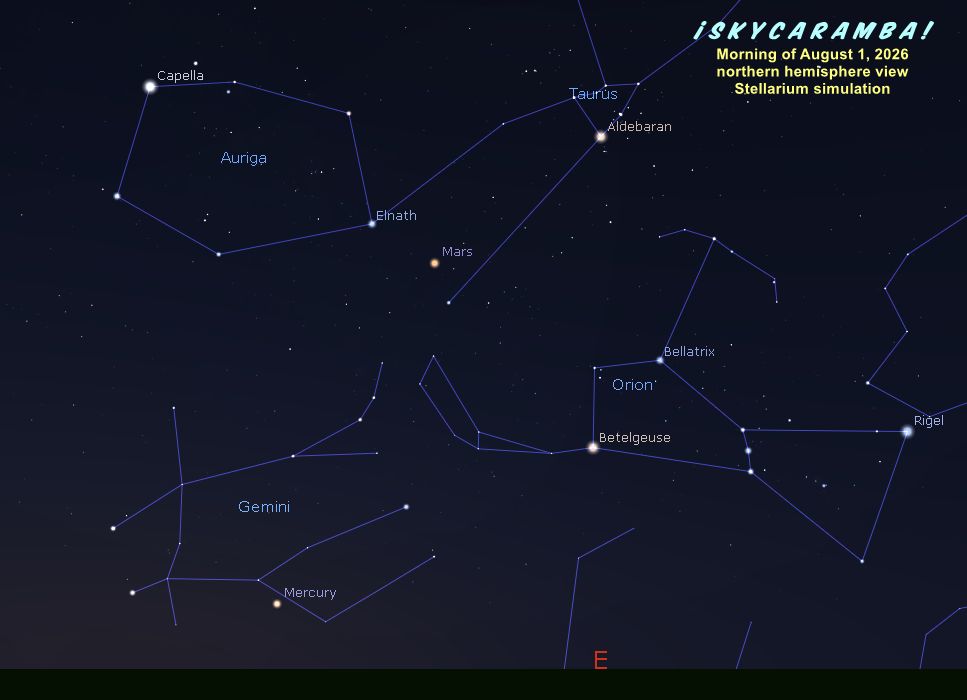
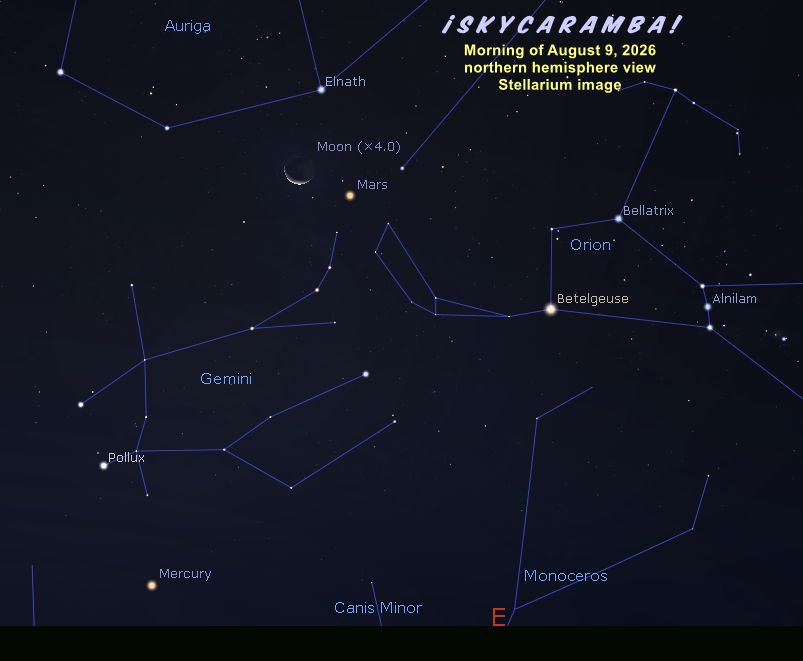
Mercury, rising closer to dawn, is on the opposite side of Gemini from Mars. It’s at greatest elongation, 19.5 degrees west of the sun on the 2nd. On the 11th, the moon passes by. The moon passes Jupiter the next morning. Mercury is moving very fast and passes Jupiter on the 15th. The two planets are 0.6 degrees apart at their closest. They are rising not long before sunrise, so you must have a clear horizon to see them very low above it before the background light is too much. The best views will be from around 15° north. For observers with telescopes, Mercury’s calculated dichotomy is on the 5th. Some observers say, like Venus, Mercury’s semi-circle phase doesn’t happen when it should. Keep watching for a few mornings. Mercury’s at perihelion on the 14th at 0.307 astronomical units from the sun.
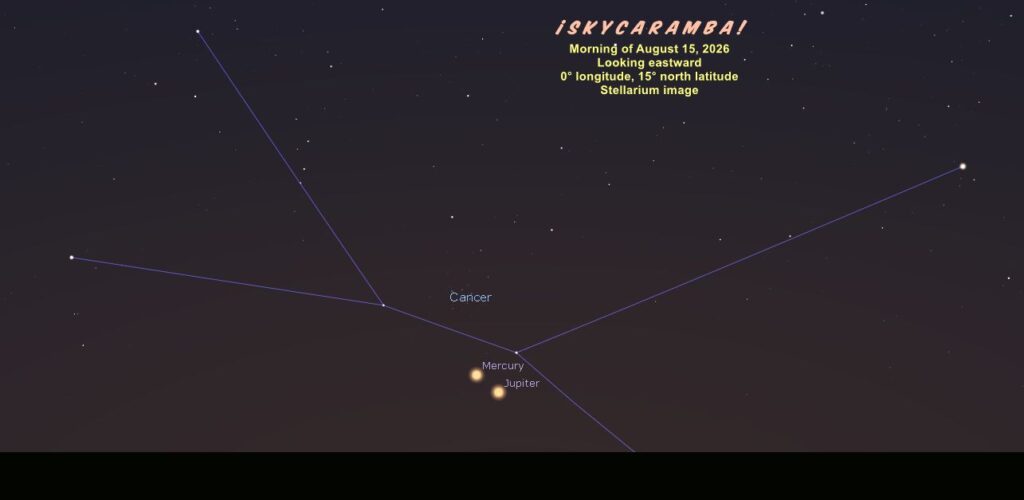
Jupiter continues its direct motion away from Cancer the rest of the month. It rises earlier each morning and gets easier to see.
Moon circumstances
The moon goes north of Earth’s equator on the 2nd. Last quarter phase is on the 6th. Northern lunistice at 28.1 degrees north is on the 8th.
Perigee occurs on the 10th at 363,200 km distance. New moon and the aforementioned total solar eclipse are on the 12th. The moon is near Regulus on the 13th. The southward equatorial crossing is on the 15th. The bright star near the moon on the 17th is Spica.
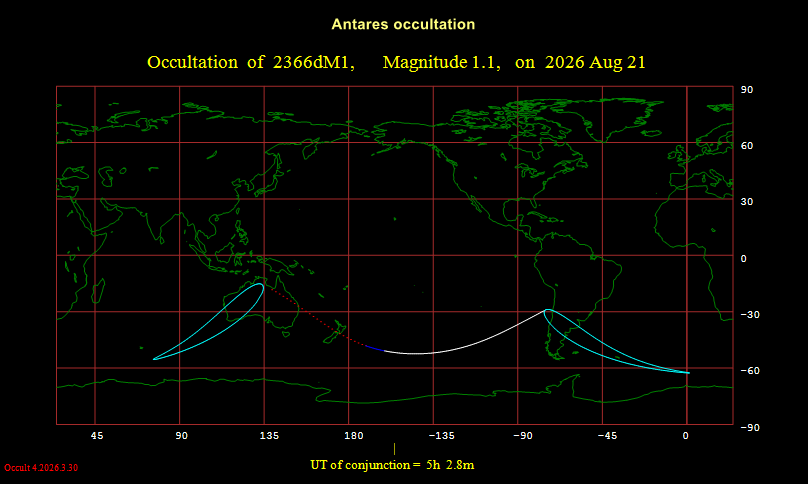
First quarter is on the 20th. The moon passes in front of Antares the same evening for sky watchers in far southern South America and the far southern Pacific Ocean to Antarctica. That will be on the 19th local time in many time zones where it’s visible.
Apogee at 404,700 km happens on the 22nd along with southern lunistice at 28.1 degrees. Full moon and the partial lunar eclipse happen on the 28th. And the moon goes north again over the equator on the 29th.
Meteor shower
We get dark skies for viewing the Perseid meteor shower. The shower’s peak is expected about the 13th. Perseus, the constellation the meteors seem to come from, rises a little before sunrise. So the best time to look for Perseids is from around midnight to dawn. This is the shower sometimes called the tears of St. Lawrence. Europe’s Christians associated the streaks of light crossing the sky this time of year with a feast held on August 10, the anniversary of Lawrence’s martyrdom in AD 258. The Roman authorities had the deacon burned to death over hot coals. We now know these meteors come from dust left by Comet Swift-Tuttle. Before the 1800s, scientists didn’t believe there were any regular meteor showers. However, religious sky watchers nearly a millennium before recognized this one, and described the meteors as a martyr’s fiery tears.