Evening
Mercury is leaving the evening sky as this month begins. It will leave the company of two other evening planets visible with the naked eye and join the company of two such planets in the morning. The messenger planet is already far enough on its journey to conjunction with the sun as July begins, it’s hard to see from most places. Those living in low latitudes will have the best chance, but only for a few nights. Inferior conjunction is on the 12th and 13th.
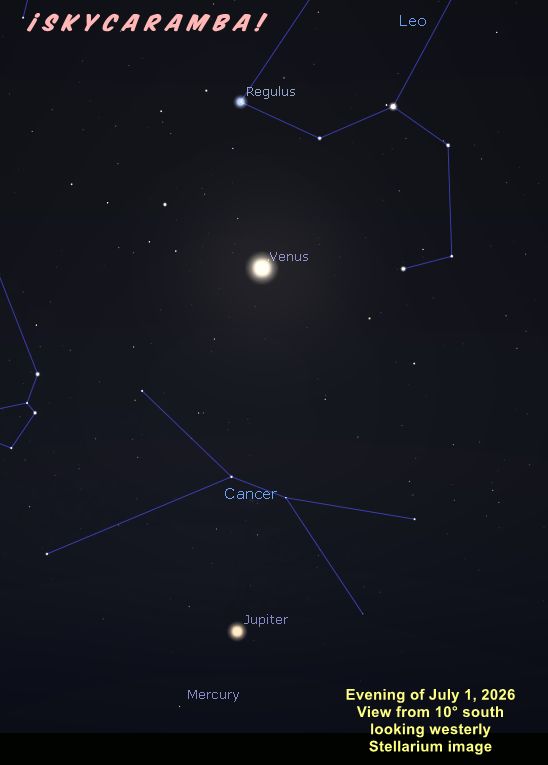
Jupiter is one of the other evening objects. It’s also heading out of the evening sky. Orbital circumstances for it are different. While Mercury is whipping around our side of the sun, Jupiter is on the other side of the sun and our planet is moving such that the sun will be between us and Jupiter on the 29th. Watch the planet getting lower and lower in the west at dusk until you can’t see it anymore. In magnified views, the Galilean moons and cloud bands will get harder to see as you have to see them through more atmosphere and also with more background light.
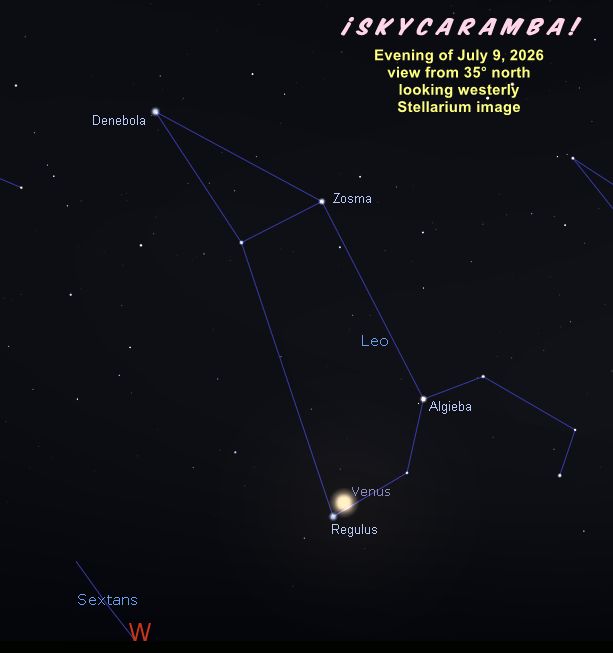
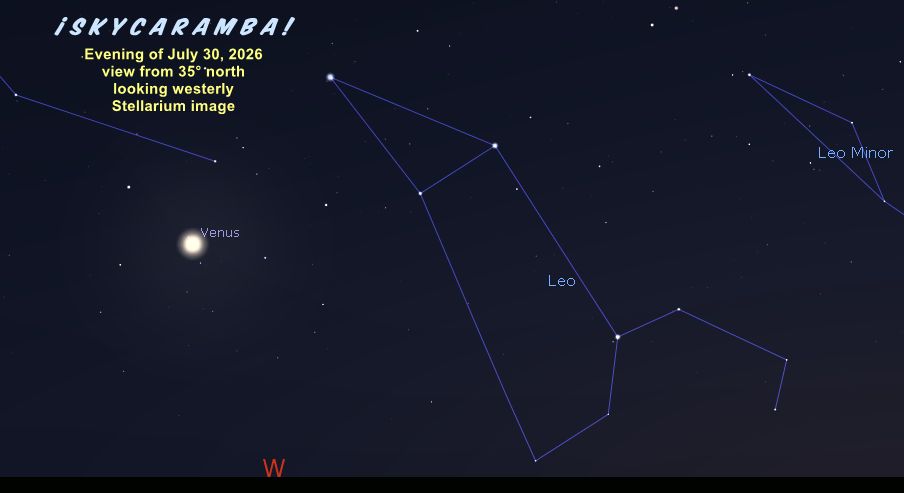
Venus stays easy to see in the west as night falls. It’s moving eastward among the stars and passes Regulus on the 9th. The planet will be as close as 1.0° from the star. A crescent moon visits Venus on the 17th. By that time, the planet is beneath the belly of Leo. At the end of July, Venus is on its way into Virgo, right at the boundary for the constellation.
All night
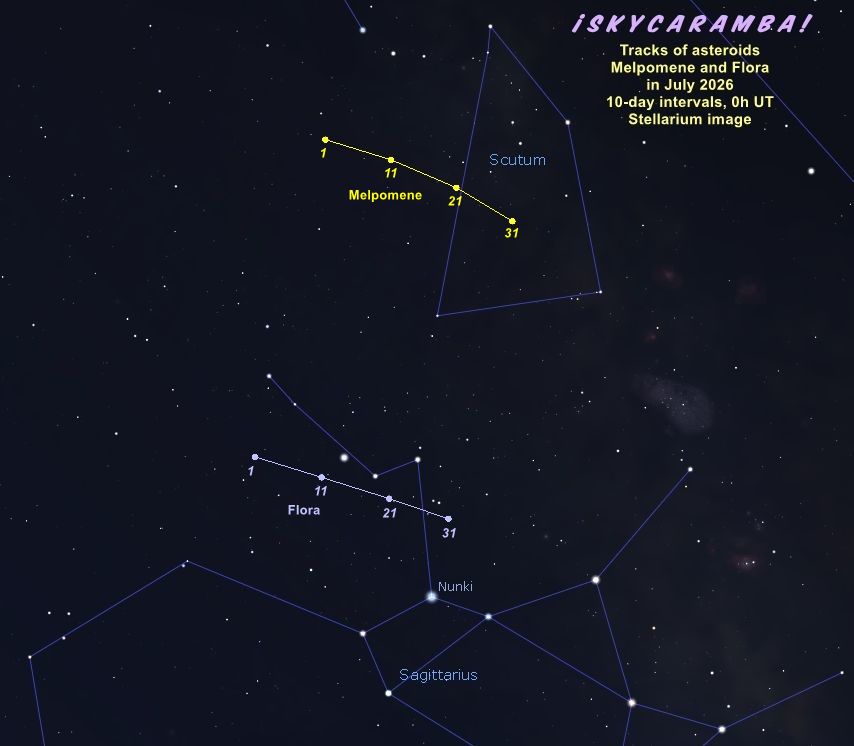
For all night sky watching, asteroids Melpomene and Flora are at opposition on the 9th. Both orbit in the asteroid belt between Mars and Jupiter. Melpomene will be 1.2 astronomical units from Earth. Flora will be slightly farther away at 1.24 a.u. Since they don’t orbit in exactly the same amount of time, many years can go by before they’re at opposition together. The last time they were was in June 1758, about two nights apart. That was nearly a century before they were both known about, although it’s possible they were seen before their discoveries by telescope users who didn’t realize what they were looking at.
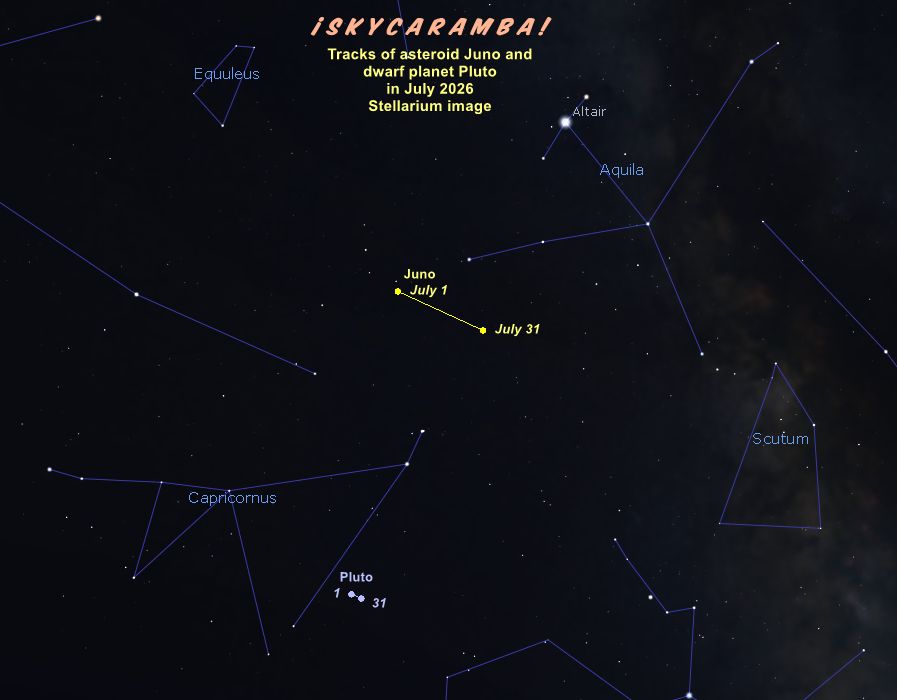
Later in the month, Juno and Pluto will be at opposition on the same date. That will be the 27th. Juno, in the asteroid belt, will be 1.80 a.u. away. Pluto, the first Kuiper Belt object ever discovered, is 34.5 a.u. away from us.
Morning
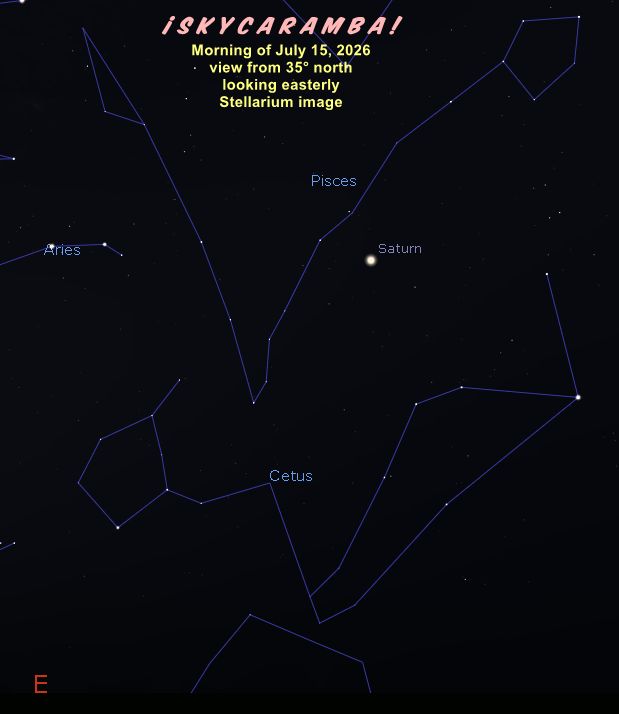
Saturn rises alongside Pisces around local midnight all month. The planet’s at western quadrature on the 6th. Quadrature is about the best time to see the planet’s shadow at its biggest on the rings behind it. Also, the moons visible in a telescope will be hidden longer as they go behind the planet. At its western quadrature, Saturn’s shadow goes eastward and its moons that orbit prograde spend the most time in the planet’s shadow before going behind the planet’s disk. Earth’s moon appears near Saturn on the 7th and 8th. Around the 21st, we get the best view of the “underside” of Saturn’s rings before orbital circumstances lessen the planet’s tilt. Saturn’s south side will be tipped toward us at 11.2°.
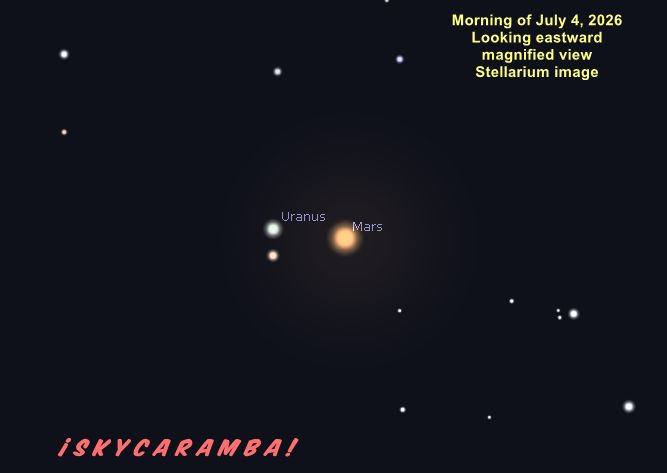
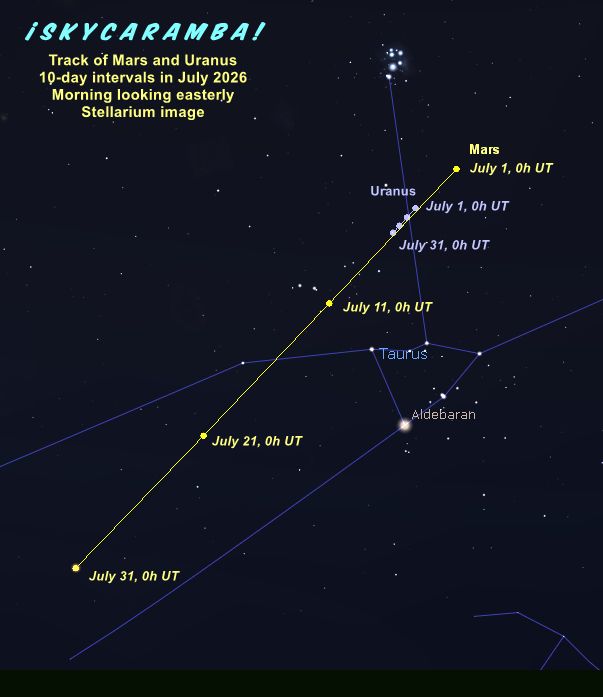
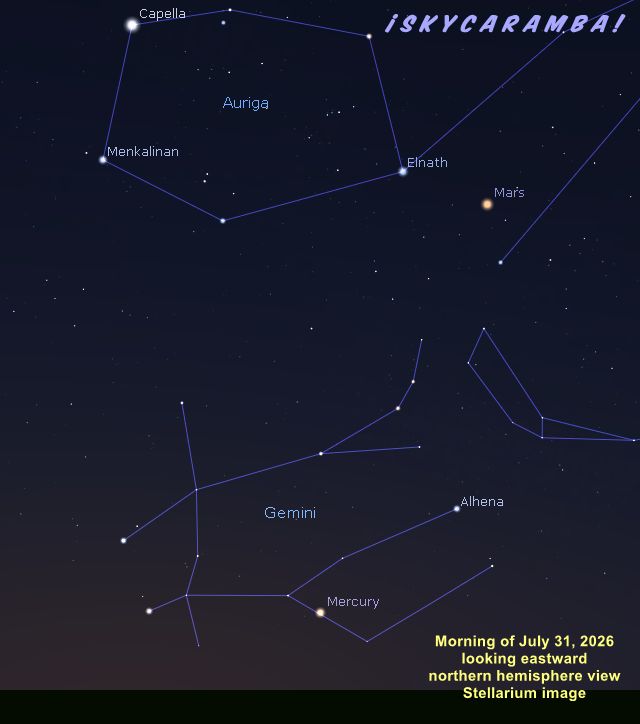
Mars and Uranus rise together at the start of the month two to three hours after local midnight. See them as close as 0.4°apart on the morning of the 4th. You’ll need binoculars to see Uranus. This would be even more spectacular if Uranus were much brighter. The two planets are between the Pleiades and the Hyades. Uranus stays just about in the same place all month, while Mars moves on. Around the 11th, when Mars is closest to Ain in the Hyades V, the moon passes by. On the 14th, the red planet looks like it’s extending the V on the side opposite also orange Aldebaran. For about a week after that, you may imagine the Hyades as a pair of tongs that Mars is trying to get away from. The month ends with Mars approaching the region between Elnath and Tianguan.
Late in the month, when Mercury becomes visible in the morning, it’s in Gemini in the legs on the Pollux side.
Moon’s circumstances
The moon crosses the equator going north on the 6th. Last quarter phase is on the 7th. Northern lunistice is on the 12th at 28.0° north. Perigee occurs on the 13th at 359,104 km away. New moon is on the 14th. The southward equatorial crossing is on the 18th. First quarter moon is on the 21st. Lunar apogee is on the 25th at 405,575 km. Southern lunistice at 28.1° is on the 26th. And full moon is on the 29th.
Planets’ orbital circumstances
Mercury goes through aphelion on the 1st at 0.47 a.u. from the sun. Earth’s aphelion is on the 6th at just under 1.02 a.u.
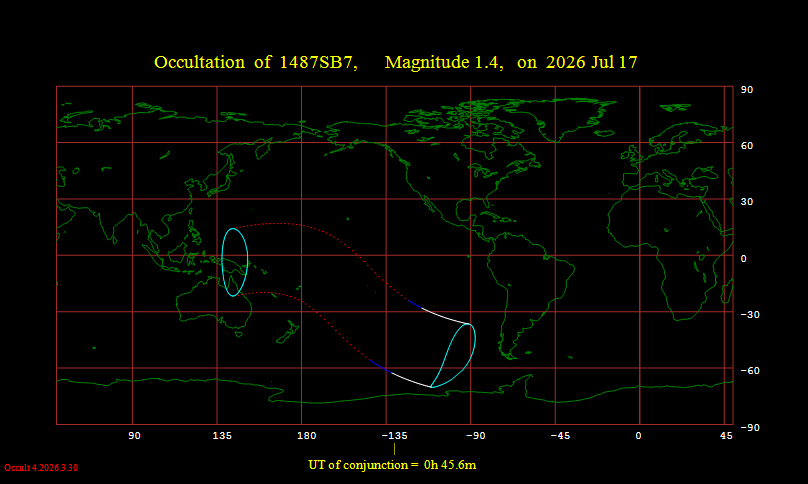
Occultation of Regulus
The moon appears to pass in front of Regulus, the bright star in Leo, on July 16-17 for observers in the southern Pacific Ocean near South America and western Antarctica. This will be on the evening of the 16th, local time.